2025 Invest in What Works State Standard of Excellence Analysis
As part of the release of the 2025 Invest in What Works State Standard of Excellence, Results for America celebrates 13 leading states for building and using evidence and data to drive taxpayer dollars toward proven solutions. Through their results-driven budgeting, grantmaking and direct services, these states are expanding early childhood education opportunities, improving mental health outcomes, reducing recidivism rates and addressing other urgent challenges facing their communities.
- Platinum: Colorado, Minnesota, Tennessee
- Gold: Maryland, North Carolina, Rhode Island
- Silver: Connecticut, Michigan, New Jersey, New Mexico, Ohio, Pennsylvania, Utah
The 2025 Invest in What Works State Standard of Excellence also recognizes the data and evidence building progress of one Honorable Mention state: Oregon.
Our 2025 Invest in What Works State Standard of Excellence evaluates all states against 12 criteria that measure how they are leveraging their budgeting, grantmaking and direct services authority to invest in what works and deliver better results for their residents. Forty-five states are represented in this year’s State Standard of Excellence.
The states featured in the 2025 Invest in What Works State Standard of Excellence invested billions of dollars in evidence-based solutions between 2022 and 2025, including Colorado ($3.4 billion ), Minnesota ($3.9 billion) and Tennessee ($2.7 billion).
Highlights from the 2025 Invest in What Works State Standard of Excellence
Investing in What Works
Our Invest in What Works State Standard of Excellence focuses on three crucial levers for evidence-based decision-making — budgeting, grantmaking and direct services.
Investing in What Works Through Budgeting
Minnesota and New Mexico are recognized for their leadership in developing and implementing their evidence-based budgeting systems to improve outcomes for their residents. Learn more about the five steps to evidence-based budgeting here.
- Minnesota is leading with transparency and accountability by including evidence indicators in public budget documents and summarizing legislative measures that support evidence-based interventions. Additionally, Minnesota incorporates evidence-based criteria within internal budget processes, ensuring state funds go toward programs that deliver measurable impact.
- New Mexico is advancing evidence-based policymaking by requiring agencies to justify budget expansion requests with evidence information. Under the Accountability in Government Act, the state defines tiers of evidence and integrates them into budget guidance. The Legislative Finance Committee enhances transparency by publishing post-session reviews that track evidence-based items signed into law or vetoed, ensuring lawmakers and the public can see how evidence is shaping policy decisions.
Investing in What Works Through Grantmaking
Michigan and Tennessee are leading the way in evidence-based grantmaking, increasingly investing in programs proven to yield positive outcomes.
- Michigan: Allocated $2 billion over three years to the Great Start Readiness Program, which provides high-quality, evidence-based preschool opportunities that have demonstrated substantial developmental benefits for children.
- Tennessee: Committed $525 million across six programs over three years, including for Evidence-Based Programming for local jails to support re-entry services for convicted felon inmates. Grantees are required to implement programs rated as highest or second-highest in the Results First Clearinghouse Database, ensuring funding prioritizes strategies proven to reduce recidivism and promote post-incarceration success.
States that define and prioritize evidence of effectiveness in grant programs can continue to nominate their programs by emailing states@results4america.org. Approved nominations will be included in future State Standards of Excellence and the Honor Roll of State Grant Programs that Define and Prioritize Evidence of Effectiveness.
Investing in What Works Through Direct Services
Across 15 states, a total of over $13 billion has been dedicated to evidence-based direct services, demonstrating bipartisan support for outcomes-focused government programs. Colorado, Minnesota and Tennessee are recognized for having the highest state investments in evidence-based direct services to improve outcomes for their residents.
- Colorado: Allocated over $3.3 billion over three years to 35 programs, including early childhood, behavioral health, human services and higher education. This includes $649.7 million invested in evidence-based Universal Preschool, ensuring broad early learning access statewide, and $319.9 million invested in Colorado Works to provide direct financial support to low-income families.
- Minnesota: Committed over $3.7 billion over three years to evidence-based programs supporting children and families. This includes $559 million invested in Universal School Meals to provide free school meals for students, and $297 million in the Child Care Assistance Program to improve affordability and supply of child care.
- Tennessee: Invested over $2.3 billion over three years in evidence-backed services across mental health, education and corrections. This includes $883 million in Home and Community-Based Services to support individuals with intellectual and developmental disabilities, and $344 million in the Tennessee Education Lottery Scholarship: Hope to help students pay for tuition and fees.
2025 Criteria Analysis
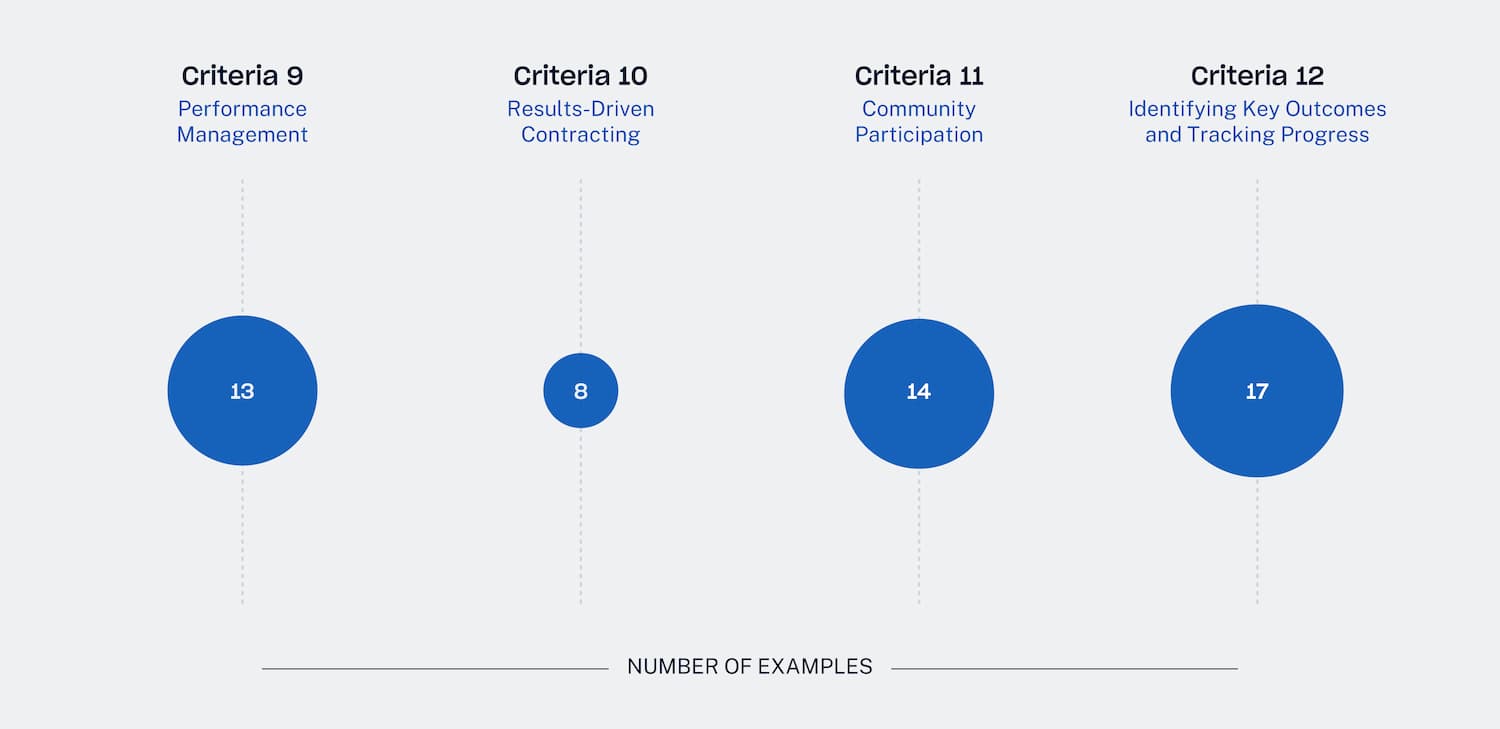
The chart below shows the number of states featured and the leading example for each criteria in 2025.
These states are leading the way:
1. Evaluation Leadership – Tennessee
2. Data Leadership – Ohio
3. Investment in Capacity to Learn What Works – Rhode Island
4. Evaluation Policy and Learning – North Carolina


5. Data Policy and Practices – Connecticut
6. Investing in What Works through Grants and Contracts – Tennessee
7. Investing in What Works through Direct Services – Colorado
8. Investing in What Works through Budgeting – Minnesota
9. Performance Management – Oregon
10. Results-Driven Contracting – Maryland
11. Community Participation – Utah
12. Identifying Key Outcomes and Tracking Progress – Pennsylvania